Almost every remake in this trade starts the same way: somebody measured on a scrap of paper, somebody else read the handwriting, and a window was cut four inches wrong. The material is gone, the week is gone, and nobody can prove what was written down because the paper is in a van.
A measurement sheet is the cheapest insurance in a fabrication shop, and it only works if it records two numbers for every opening: what you quoted, and what the wall actually is.
Features
One row per opening
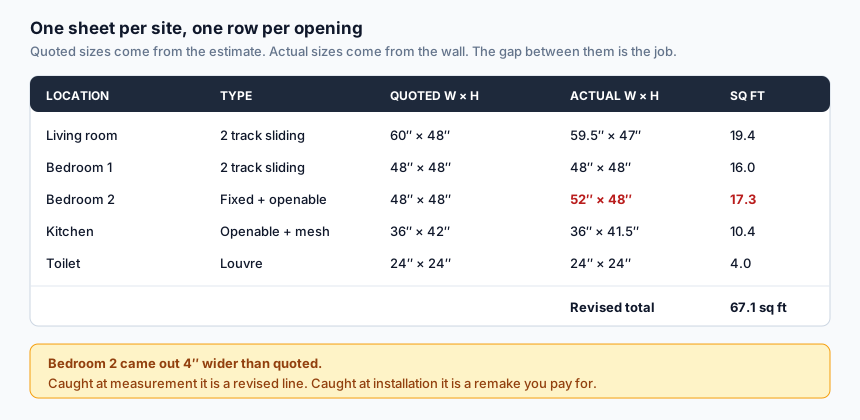
Location, type, width and height, in the order you walk the house. Living room, bedroom one, bedroom two, kitchen, toilet. The sheet reads like the site.
Quoted size and actual size side by side
The quoted dimensions come from the estimate; the actual ones you type at site. The gap between them is visible immediately, which is the entire point — a four-inch difference found at measurement is a revised line, and the same difference found at installation is a remake you pay for.
Area recalculated from the real sizes
The revised total square footage follows from the actual dimensions, so you know before fabrication whether the job grew or shrank and by how much.
Works on the phone, at site
The Android app and the mobile web both take measurements without a signal problem turning into lost work. Type the sizes while you are standing in the room, not from memory in the van.
Measurement sheet as a document
Print it, download it as a PDF, or send it. The fabricator in the workshop cuts from the same sheet the measurer filled in — not from a WhatsApp photo of a notebook.
Attached to the job, not loose
The sheet lives against the quotation and the customer, so when a question comes up three months later the sizes are where the job is.
Benefits
- Fewer remakes. This is the whole argument. One avoided remake on a sliding window pays for a year of software that costs nothing anyway.
- Disputes end quickly. "We measured 48, you have fitted 44" is settled by a document with a date on it.
- The workshop stops interpreting handwriting. Typed sizes do not have a 7 that might be a 1.
- Scope creep becomes visible and billable. When the actual area is larger than the quoted area, that is a revision, not a gift.
- Anyone can take the measurement. A helper filling in a structured sheet makes fewer mistakes than an experienced fitter filling in a blank page.
How it works
- Open the approved quotation for the job.
- Go to measurements — the quoted openings are already listed.
- Walk the site and enter the actual width and height for each opening.
- Check the revised area against the quoted area before you leave.
- Raise a revision if the difference is material enough to change the price.
- Print or send the measurement sheet to whoever is cutting.
What to measure, and how
Two practical rules save most of the trouble:
- Measure the opening in three places. Width at the top, middle and bottom; height at the left, middle and right. Old masonry is rarely square. Take the smallest of the three, and note that you did.
- Record the finished opening, not the brickwork. If plaster or cladding is still to come, say so on the sheet — the difference is usually an inch, which is exactly enough to make a frame not fit.
Who this is for
Aluminium and UPVC fabricators measuring their own jobs; shops sending a helper to measure; dealers who measure for a supplier's workshop; and anyone who has paid for a remake caused by handwriting.
Frequently asked questions
Is the measurement app free?
Yes, and so are quotations, invoices, site visits and payment tracking. See what is free and what is paid.
Does it work offline at a site with no signal?
It needs a connection to save. In practice, measure room by room and save as you go; where the signal is bad, write the sizes into the sheet when you are back in range, while the site is still fresh. We would rather tell you that than claim an offline mode that does not exist.
Can it work out the frame size from the opening size?
No. Deductions depend on your system, your fixing method and whether the plaster is done, and a wrong automatic deduction is worse than none. The sheet records what you measured; the deduction stays your decision.
Can two people measure the same job?
On the free account the measurements belong to your login. Staff accounts, which let somebody else record against the same job, are part of the paid plan.
Does it handle both aluminium and UPVC?
Yes. The sheet is the same — location, type, quoted size, actual size, area — and the type column carries whatever system you are fitting.
Can I attach photos of the opening?
Site photographs are kept against installations and project records rather than on the measurement sheet itself.
Related
Aluminium quotation software · UPVC quotation software · Site visit management · Seven measurement mistakes
Start using it
Create an account, open a quotation, and see whether the numbers come out the way you work. Nothing is charged for the tools listed above, and there is no trial clock running in the background.
Create a free account · See every tool · What is free and what is paid