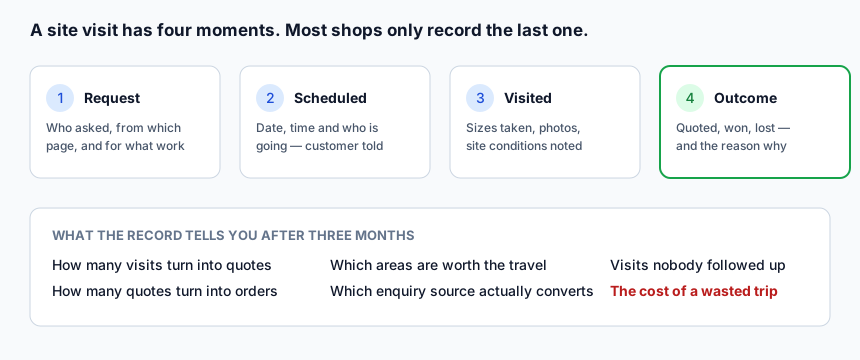
Ask most fabrication shops how many site visits they did last month and you get a shrug. Ask how many turned into orders and you get a different shrug. Yet the site visit is the most expensive thing a small shop does — two people, a vehicle, half a day — and it is the one activity nobody records.
This is a record of every visit, from the enquiry that caused it to the job it did or did not become.
Features
Requests captured with their source
A visit request records who asked, their number, the location, the work they want, and which page of your profile they came from. Requests that arrive through your TrueInstaller profile land here automatically.
Scheduling with the customer told
Set the date and time, and the customer gets confirmation rather than waiting in for a visit that was never actually fixed.
A form you decide the shape of
The site visit form settings let you choose what gets asked and captured, so the visit collects what your trade actually needs instead of a generic template.
Outcome recorded, including the losses
Quoted, won, lost — and why. The lost ones are the useful data. Three months of "lost on price" and three months of "customer never came back" are two completely different problems.
Visits linked to quotations and measurements
The visit, the sizes taken on it, the quotation that followed and the invoice all sit against the same customer.
Appointments your team can see
Visits appear as appointments, so the week is visible instead of living in one person's phone.
Benefits
- You find out what a visit costs you. Once the count is real, the arithmetic of travelling forty kilometres for a two-window enquiry becomes obvious.
- Follow-ups stop falling through. The commonest reason a visit produces no order is that nobody sent the quotation.
- You learn which areas and which enquiry sources are worth it.
- Customers stop being told different things. One record, one agreed date, one note of what was discussed.
- The handover to the workshop is clean, because the sizes and the site conditions were written down at the time.
How it works
- A request arrives — from your profile, or entered by you after a phone call.
- Schedule it with a date, a time and the person going.
- The customer is told what was fixed.
- At site, record what you found — sizes, access, site conditions, what the customer actually wants.
- Quote from it, carrying the sizes into a quotation.
- Close the visit with an outcome, so next month's numbers mean something.
Who this is for
Fabricators and installers who travel to quote; shops with more than one person taking enquiries; and anyone whose follow-up currently lives in a phone's call history.
Frequently asked questions
Is the site visit software free?
Yes. Site visit requests, scheduling and the visit record are in the free account.
Do customers book visits themselves?
They can request one through your public profile on TrueInstaller, and you confirm the date. You can also enter a request yourself after a phone call, which is how most of them start.
Can I change what the visit form asks?
Yes, through the site visit form settings. What you capture on a railing visit is not what you capture on a UPVC window visit.
Does it send reminders?
Confirmation goes to the customer when the visit is booked. WhatsApp messaging beyond that uses sending credits, which are a paid item.
Can I see all visits for one customer?
Yes. Visits, quotations, measurements and invoices are all held against the customer record.
What if the visit does not lead to a job?
Close it as lost with a reason. Those records are the ones that change how you price and where you travel.
Related
Measurement sheets · Payment tracking · Staff management · All tools
Start using it
Create an account, open a quotation, and see whether the numbers come out the way you work. Nothing is charged for the tools listed above, and there is no trial clock running in the background.
Create a free account · See every tool · What is free and what is paid